Principles
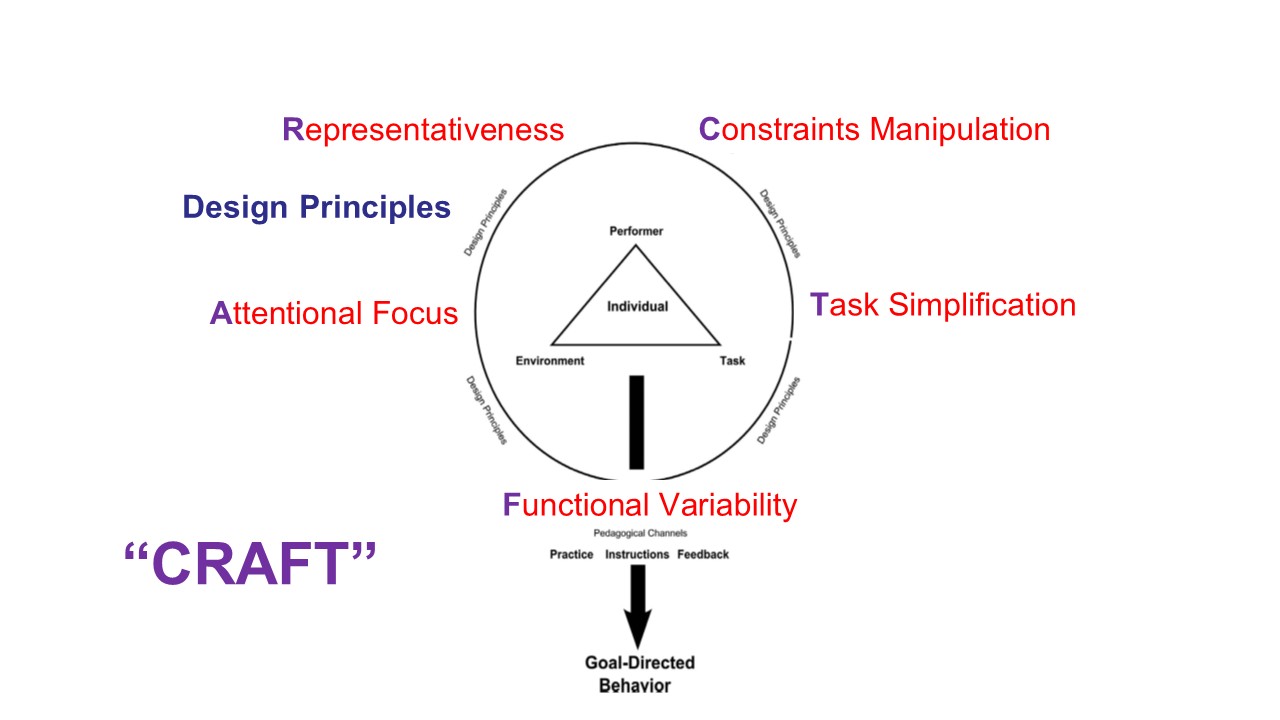
Constraints Manipulation
Nonlinear Pedagogy advocates the manipulation of task constraints such as instructions, rules of the activity, and equipment (e.g., racquets, balls, court size), to encourage learners to explore various movements solutions most suitable for themselves.
References
- Lee, M. C., Chow, J. Y., Komar, J., Tan, C. W., & Button, C. (2014). Nonlinear pedagogy: an effective approach to cater for individual differences in learning a sports skill. PloS one, 9(8), e104744. https://doi.org/10.1371/journal.pone.0104744
- NA
Representative Learning Design
Nonlinear Pedagogy emphasizes the importance of a representative learning design in which learning is situated in real-game contexts. When placed in representative learning environments, information-movement couplings relevant to the desired sports skill are presented to the learner, providing functional affordances (i.e., opportunities for action) for the individual.
References
- Lee, M. C., Chow, J. Y., Komar, J., Tan, C. W., & Button, C. (2014). Nonlinear pedagogy: an effective approach to cater for individual differences in learning a sports skill. PloS one, 9(8), e104744. https://doi.org/10.1371/journal.pone.0104744
- NA
Attentional Focus
The impact of instructions based on an external focus of attention that seems to reduce conscious and explicit control of movement. Instructions to learners can be varied by guiding them to focus attention on either the effects of a movement on the environment (i.e., the outcomes of an action) or on body movements (i.e., limb segments) involved in producing an action, respectively.
References
- Chow, J. Y. (2013). Nonlinear Learning Underpinning Pedagogy: Evidence, Challenges, and Implications. Quest, 65(4), 469–484. https://doi.org/10.1080/00336297.2013.807746
- NA
Functional Variability
An important aspect of nonlinear pedagogy is associated with the role of functional movement variability in enhancing acquisition of coordination since movement variability is seen as a feature of nonlinearity in human learning. ‘Noise’ amplifies the exploratory activity and may guide the learner to discover individualized functional solutions to a specific task goal. Nonlinear pedagogy incorporates and recognizes the critical role of infusing perturbation (e.g., in the form of encouraging variability in practice conditions) in a learning environment to allow for exploratory learning and greater search in the perceptual motor workspace of the individual. This is especially relevant when a learner is stuck in a rut and the coach can incorporate a perturbation to the practice by altering task constraints such as instructions or equipment to challenge the learner to try new coordination patterns.
References
- Chow, J. Y. (2013). Nonlinear Learning Underpinning Pedagogy: Evidence, Challenges, and Implications. Quest, 65(4), 469–484. https://doi.org/10.1080/00336297.2013.807746
- NA
Task Simplification
Task simplification, a key design pedagogical principle in Nonlinear Pedagogy can provide simple informational constraints that promotes the coupling of perception-action for learners to explore individualised movement solutions. Although, the whole-part-whole practice has been also seen as task simplification in the motor learning literature, it further relates to task decomposition. From an Ecological Dynamics perspective, task simplification is about reducing the temporal and spatial difficulty and still maintaining the complexity of the task.
References
- Chow, J. Y., Loh, W. T., Low, K. L. F., & Seifert, L. (2025). The impact of task simplification in skill acquisition for young children from a simplexity approach. Acta Psychologica, 258, Article 105143.https://doi.org/10.1016/j.actpsy.2025.105143
- NA